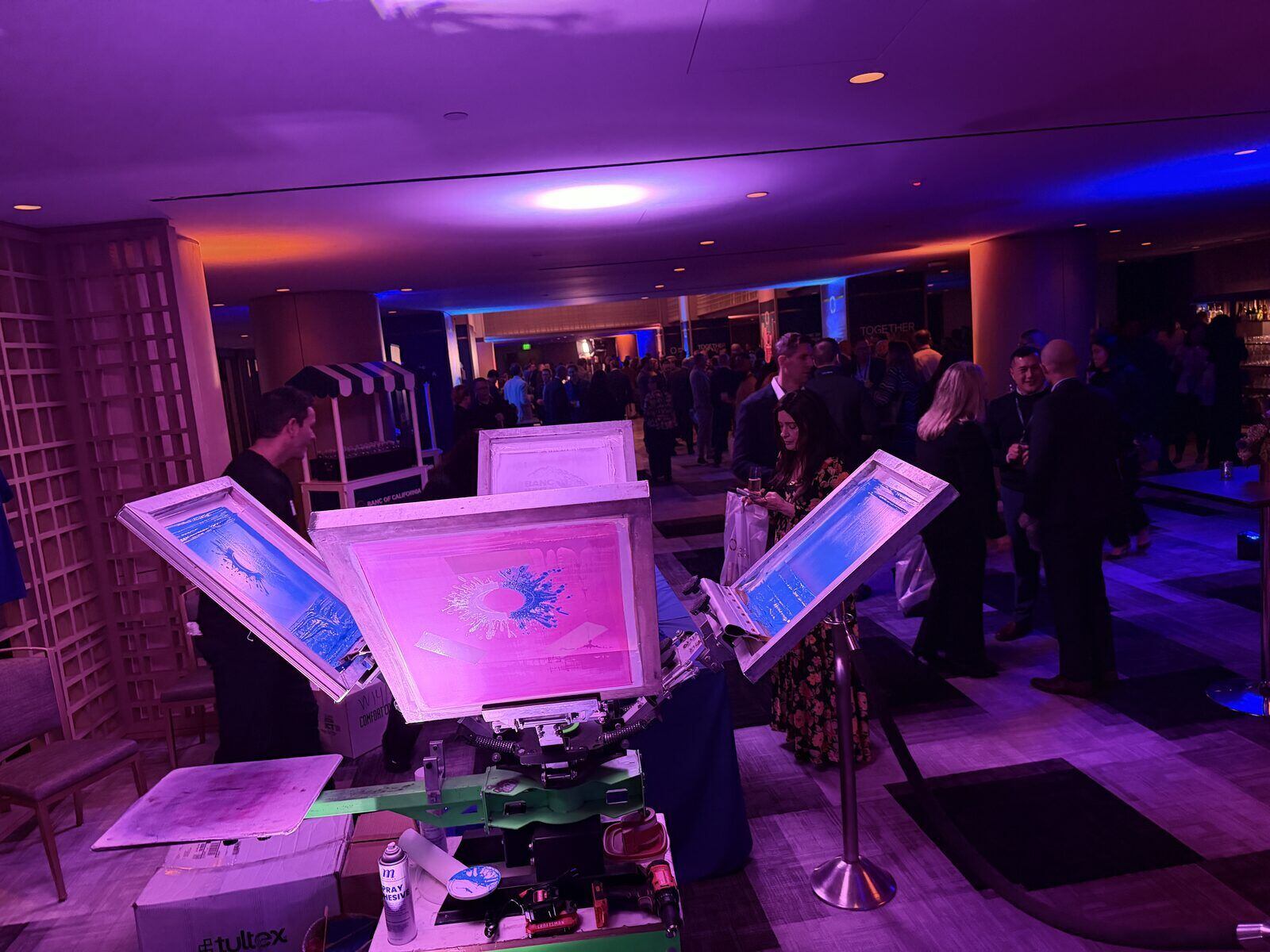
A live-printing station is a small, hungry machine. It wants a flat 10×10 corner, two clean 120V circuits, a path to roll gear in on, and a spot where the line out front reads as a moment instead of a hazard. Drop that station into the right room and it becomes the thing guests film and the thing they walk out wearing. Drop it into the wrong corner of a giant hall — no power, a quarter-mile from the freight door, tucked behind a pillar — and the best crew in LA can’t save it. The venues we work most in Los Angeles each ask for something different. Here’s what actually matters at each, before you sign a floor plan.
The Los Angeles Convention Center — the rules are the room
The LACC is the biggest stage we play, and it’s the one where the building’s rules shape the job more than the square footage does. It’s a union house with an in-house electrical and labor structure, so you almost never plug a press straight into a house outlet yourself — you order power through the show’s electrical contractor, by the circuit, in advance. Spell it out on the order: two dedicated 120V/20A circuits per station, because our flash dryers pull real current and you do not want to share a circuit with a neighbor’s espresso cart and trip it mid-event.
Load-in runs through the marshaling yard and the freight docks off the South or West halls; everything rolls in on carts during your assigned dock window, and that window is the law. Confirm whether your booth labor (uncrating, placement) has to go through house teamsters, and order it early — same-day labor at a convention center is the expensive way to learn this. Place the station at the mouth of an aisle or beside a feature wall where the floor naturally pools, not buried mid-booth. On an expo floor, your line is your booth traffic. For the trade-show playbook specifically, see our notes on live printing at trade shows.
The one-line LACC rule of thumb: order power and labor by the circuit and by the hour, in writing, ahead of time. Walk-up requests at a union convention hall are slow and costly. We’ll hand you the exact electrical spec — two 120V circuits per station — to drop into your order.
The Novo at L.A. Live — a built room with a real dock
The Novo is a purpose-built venue, which is a gift after a raw warehouse: house power is plentiful, the load-in dock is built for production, and the staff run events nightly so they know what a vendor needs. For a label launch, an award-season party, or a premiere after-party, this is an easy room to print in. The thing to negotiate is where: a venue this size has a flow, and you want the station on the path between the entrance and the bar, not parked in a side lounge nobody crosses. Ask the event manager where the crowd actually pools once doors open, then claim that 10×10.
Goya, Quixote & Smashbox — studios that double as venues
Goya Studios, Quixote Studios, and Smashbox Studios are soundstages and shoot spaces that moonlight as event venues, and they share a profile. The good news: these are production buildings, so they have serious power, wide roll-up doors, and ground-level load-in built for grip trucks — a press cart is nothing to them. The catch is that power is often distributed for film lighting, not for a vendor in the corner, so confirm the two 120V circuits at your specific spot rather than assuming the wall has them. These rooms also photograph beautifully, which matters: at a Goya music-label launch or a Smashbox beauty activation, the station becomes part of the set, so place it inside the lit area where the cameras already are, not off in service shadow. For full-color, per-guest pieces in those camera-ready rooms we’ll usually run live DTF printing; for a build-your-own moment, a live hat bar turns it into a choice guests make.
The Reef — big open floors, confirm the circuits
The Reef in South Park is a workhorse for larger activations: wide column-free floors, freight elevators, and the kind of square footage that swallows a multi-station setup without anyone feeling crowded. Because it’s a converted commercial building rather than a purpose-built venue, treat power as a question to ask, not a thing to assume — check whether your floor and corner have house circuits you can tap or whether the producer is bringing in distro. With room to spread out, you can run two or three stations and clear 100-plus shirts an hour, but that only works if each one has its own two circuits. Place the stations to catch the natural traffic between the elevator bank and the main floor.
Studio lots — Warner Bros, Universal, and the access dance
When the brand is the studio — a fan event, a press junket, a premiere-week pop-up — you’re printing on a lot, and lot access is its own logistics. Drive-on passes, a security advance, a designated dock or stage door, and a vehicle list submitted days ahead are all standard. Once you’re inside, the soundstages themselves behave like the studio venues above: strong power, easy ground-level load-in, plenty of room. Build an extra hour of buffer into your call time for the gate and the escort, confirm the two 120V circuits at the stage, and the printing is the easy part.
The four questions that decide every venue
Strip away the names and every one of these rooms comes down to the same short checklist. Before we commit a station to a floor plan, we want to know:
- Power. Two dedicated 120V circuits per station, full stop. At a union house you order them; at a studio or warehouse you confirm them at your exact spot.
- Footprint. A flat 10×10 ft per station, indoors or out. More stations means more throughput — and more circuits.
- Load-in. A freight door, dock, or ground-level roll-in beats a flight of stairs every time. Know your dock window and whether house labor is required.
- Placement. Put the station where the floor already pools — aisle mouth, entrance, bar, photo wall. A press in a back corner gets no line, and the line is the whole point.
Get those four right and the rest is just good printing: real presses pulled in front of the crowd, full-color DTF, hats, embroidery, or promo — whatever fits the room and the brand. Most LA events land between $5K and $15K all-in, with one number covering crew, gear, garments, setup, teardown, and every print, and there’s no travel fee anywhere in LA County. Brands like Dickies have run live printing at their events, and the station earns its square footage the same way every time: guests film it, then walk the rest of the night wearing the logo.
Still mapping which room fits your event? Start with the neighborhoods in our Los Angeles areas guide, or read where to host an LA pop-up for a venue shortlist by vibe. When you’ve locked a space, tell us the venue and headcount and we’ll send an itemized quote within 24 hours — with the exact power and footprint spec your venue manager will ask for.