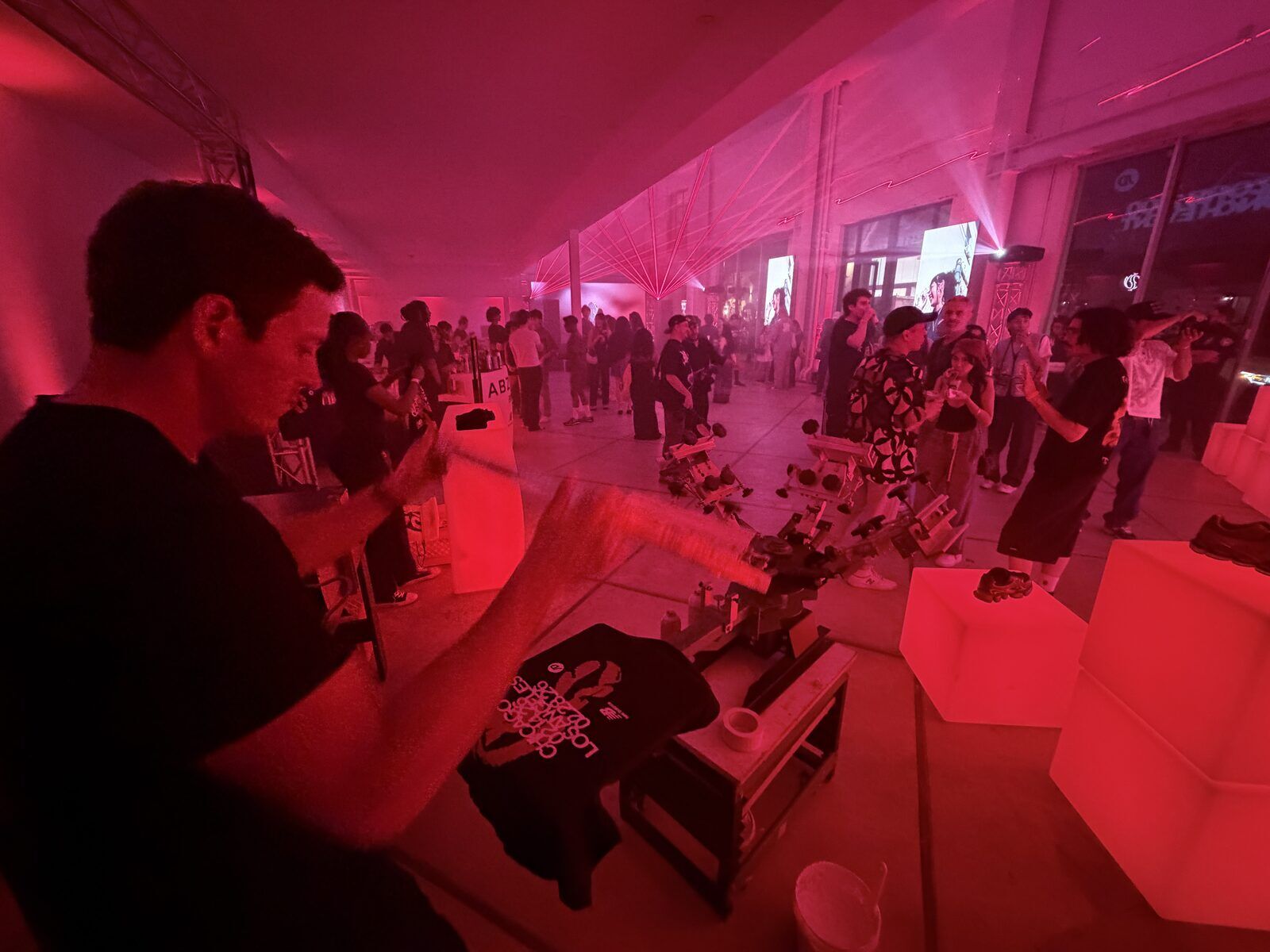
Three hundred shirts in four hours sounds like a stunt until you see the math. It isn’t. It’s a known quantity — a product launch with a single bold design, two manual presses, two printers, and a run-of-show that respects the press the same way it respects the DJ and the open bar. This is how a typical LA product-launch run actually goes, hour by hour, from the art proof to the last shirt off the platen. Live screen printing is only one of the stations we run, but for a high-volume drop with one or two strong logo colors, nothing else moves shirts this fast in front of a crowd.
Days before: the art proof and the screen burn
The 300-shirt night is won a week earlier, in a quiet room with no crowd. Screen printing is a physical process — every ink color needs its own screen, and every screen has to be burned, taped, and registered before it ever touches the floor. So the first thing we lock is the art: vector files, a confirmed Pantone or two, and a digital proof the brand signs off on. For a launch we keep the design to one or two colors on purpose. One bold mark prints clean, dries fast, and — critically — never becomes the bottleneck that turns a four-hour window into six.
Once art is approved, we burn the screens in advance and stage the whole rig. Ink is mixed to the launch color, blanks are pulled in the full size run, and the press is dialed in and test-pulled before it ever leaves the shop. By load-in day, nothing about the print is still a question. That’s the difference between a press that runs and a press that stalls.
Load-in: setting up around the run-of-show
We treat the press station like any other production element on the call sheet. Each station needs about a 10x10 ft footprint and two standard 120V circuits — the second circuit is for the flash dryer that cures each print so the shirt is wearable, not wet, the moment it’s handed over. We confirm power and placement before the date, not on the day.
Placement is its own decision. The station goes where guests already pool — near the entrance, the bar, or the photo moment — because a press tucked in a back hallway gets no line, and the line is half the point. We load in during the build window, register the screens to the platens, run a couple of test pulls to confirm color and cure, and we’re hot before doors. When the room fills, the crew is already printing.
The math: why 300 in 4 hours is realistic
Here’s the engine. A single manual press in trained hands turns out up to 60 shirts an hour. The standard rig is two presses and two printers, so at full tilt the station clears 100-plus shirts an hour — roughly two minutes per finished shirt, print to fold. Four hours of real printing time at that rate is 400 shirts of headroom. Three hundred fits comfortably inside it.
That comfort margin is deliberate. Real events have surges and lulls — a rush when a keynote lets out, a quiet stretch during a toast. Building to 400 capacity for a 300 goal means the line never outruns the press during the surge, and the crew isn’t standing idle in the lull. The single-color design is what protects the rate: one screen, one pull, one flash, fold. Add a second or third color and every shirt takes longer, which is exactly why we settle color count during the proof, not on the floor.
The honest rule of thumb: one bold design plus the standard two-press, two-printer rig equals about 100 shirts an hour. If your headcount and your window don’t pencil out at that rate, the fix is a third press or a tighter design — not asking two printers to magically print faster.
Managing the line (and the size run)
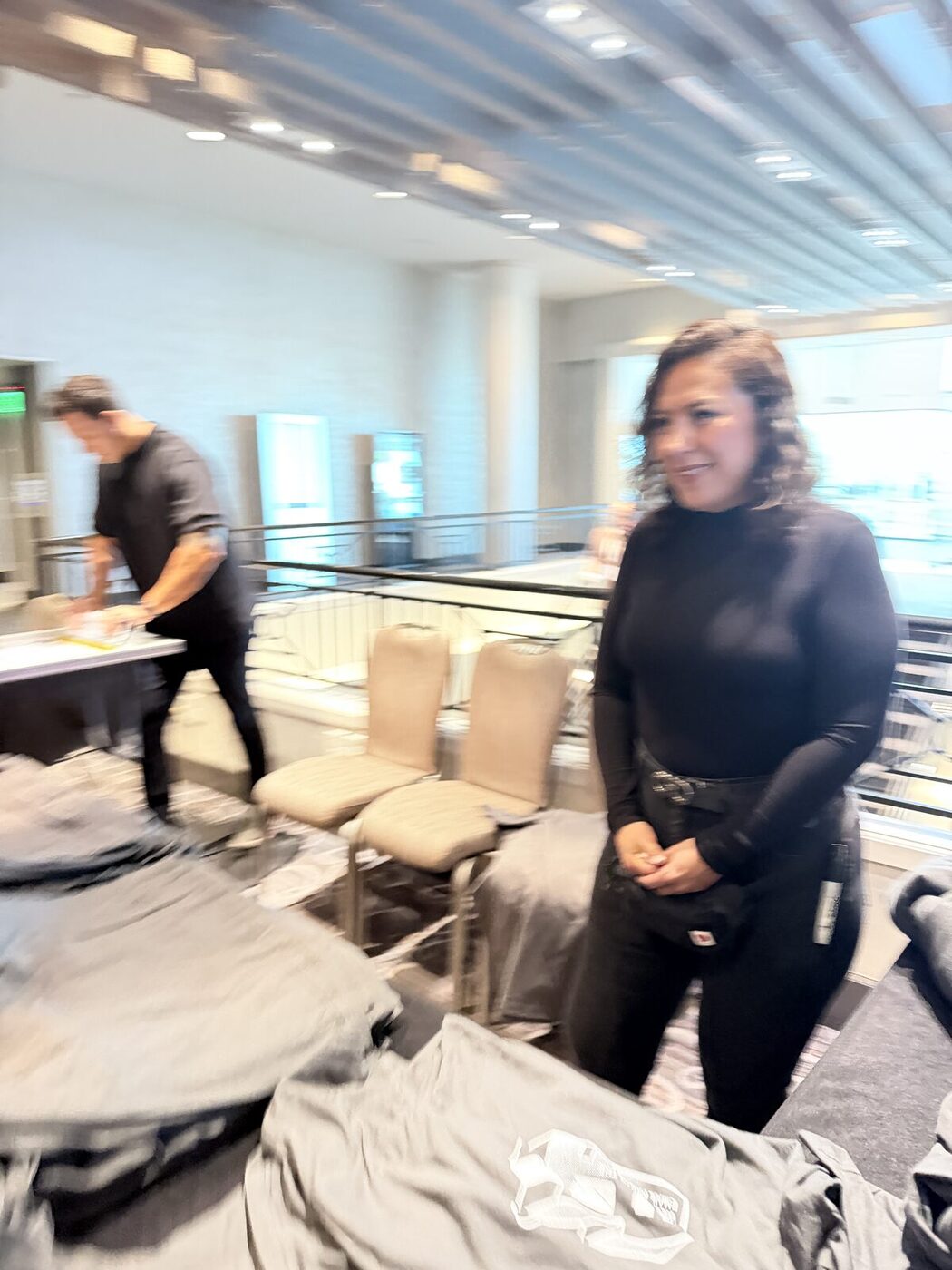
The press sets the ceiling; the line is what keeps you under it. We print on demand — only the shirts guests actually want, in the size they actually wear — so we don’t waste pulls on a stack of mediums nobody claims. We carry blanks XS through 4XL on hand, which matters more than people expect: a launch crowd is every body type, and the brand moment lands differently when the 4XL guest and the XS guest both walk away in the same fresh print.
Operationally, the trick is to take the size at the front of the line, not at the press. A runner asks the size, the printer pulls the matching blank, and the platen never sits empty waiting on a decision. Done right, the queue reads as energy — people filming the squeegee, holding up the shirt they just watched get made — instead of a stalled clump near the exit. Brands like Dickies have run live printing at their events for exactly that reason: the line is the activation.
Teardown: clean break, no trace
When the window closes, we print the last claimed shirt and stop — we don’t leave a pile of unworn blanks behind, because we only printed what was wanted. Wet screens, flash dryers, and ink get broken down and crated; the 10x10 footprint goes back to floor. The rig that took a week of prep tears out in a fraction of that, and the venue gets its room back the way it found it. The only evidence the press was ever there is 300 people walking around the rest of the night in the launch logo.
Is screen printing the right station for your launch?
Not always — and we’ll tell you when it isn’t. Live screen printing is the move for high volume on one or two strong colors. If the design needs gradients, photos, full color, or per-guest personalization, we’d run live DTF printing instead, which skips screens entirely. For the classic high-volume launch tee, though, live screen printing is still the fastest, most cinematic way to put your logo on 300 chests in an afternoon.
Most LA launches land between $5K and $15K all-in — crew, presses, blanks, setup and teardown, and every print under one number. The big levers are guest count, printing hours, garment choice, and how many stations you run; our breakdown of what live printing costs in LA walks through how those add up, and the pricing page covers what’s included. Tell us your date, your headcount, and your window, and we’ll send an itemized quote within 24 hours — with the press math already done.